
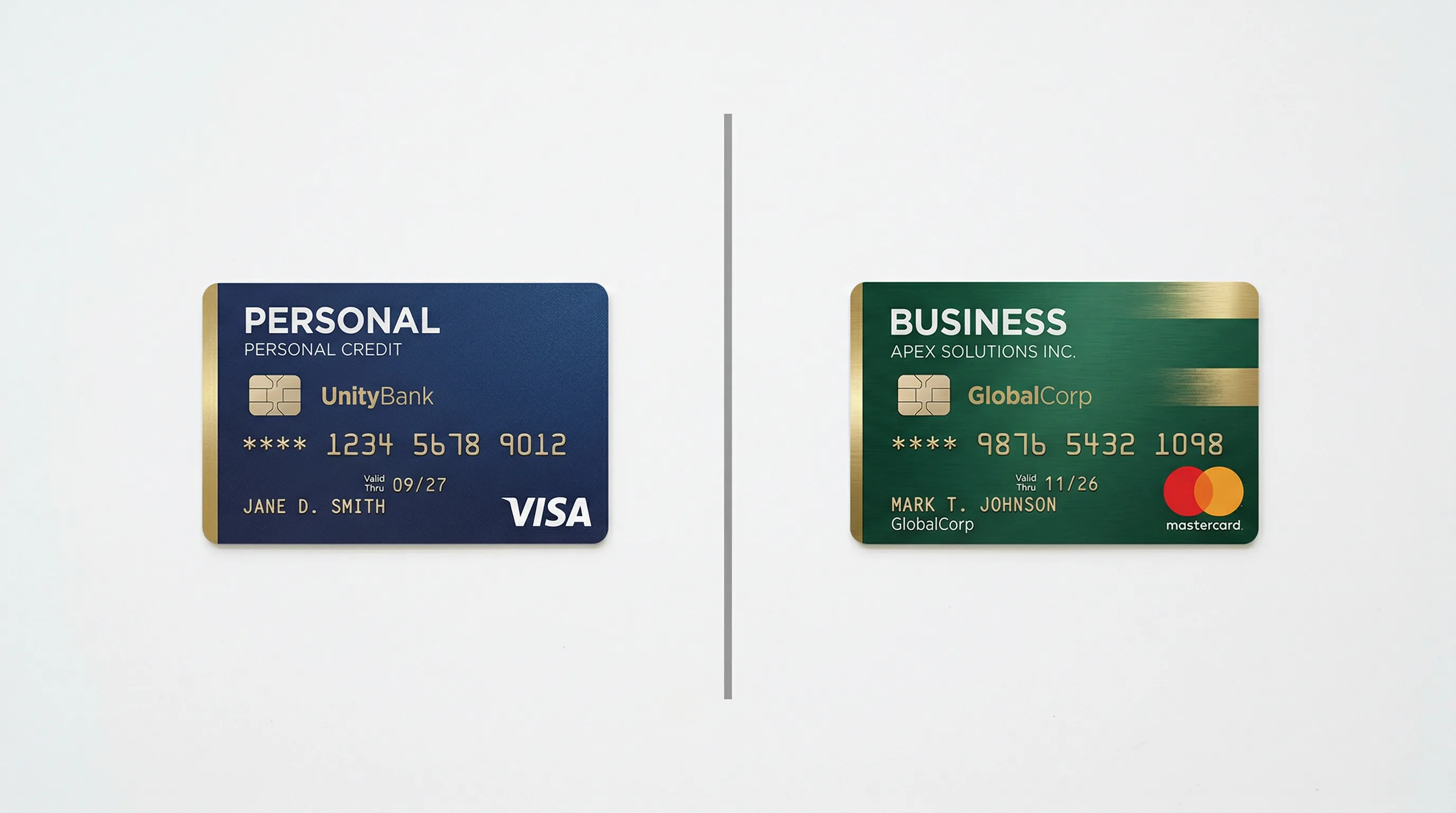
Many Canadian entrepreneurs start by running all their business expenses through a personal credit card. It is convenient, familiar, and requires no additional application. But as your business grows, this shortcut can create real problems — from tangled finances at tax time to missed opportunities for higher credit limits and rewards optimized for business spending.
Understanding the differences between a business credit card and a personal credit card is one of the most important financial decisions a Canadian entrepreneur can make. This guide breaks down every key distinction so you can make an informed choice.
At a Glance: Business vs Personal Credit Card
| Feature | Personal Credit Card | Business Credit Card |
|---|---|---|
| Legal Liability | Cardholder personally liable | Personal guarantee often required; incorporated businesses may qualify for corporate liability |
| Credit Reporting | Reports to personal credit bureaus (Equifax, TransUnion) | Typically reports to business credit bureaus (Dun & Bradstreet, Equifax Business) |
| Credit Limit | Based on personal income; typically lower | Based on business revenue; often significantly higher |
| Annual Fee Tax Deductibility | Not deductible | Deductible as a business expense |
| Employee Cards | Limited or unavailable | Up to 99 additional cards on some products |
| Expense Tracking | Basic statement | Advanced reporting, accounting software integration, receipt capture |
| Rewards Categories | Optimized for personal spending (groceries, dining) | Optimized for business spending (office supplies, gas, telecom, travel) |
| Consumer Protections | Full federal and provincial consumer protection | Reduced protections in some provinces (business is not a consumer) |
Legal Liability: Personal Guarantee vs Corporate Liability
One of the biggest differences between personal and business credit cards is how liability is structured — and who is on the hook if things go wrong.
Personal Credit Cards
With a personal credit card, you as the individual are always personally liable for the balance. The card is issued in your name, and any unpaid debt attaches to you personally.
Business Credit Cards: Personal Guarantees
Most Canadian business credit cards — including those from the Big 5 banks and American Express — require a personal guarantee when you apply. This means even though the card is issued to your business, you as the owner are still personally liable for unpaid balances. If the business cannot pay, the issuer can pursue you personally.
However, there are exceptions. Fintech corporate cards like Float and Loop are notable precisely because they do not require a personal guarantee. Float offers credit limits up to $3 million in unsecured credit without requiring the business owner to pledge personal assets. Loop similarly approves businesses based on company revenue rather than personal credit history. For incorporated businesses concerned about protecting personal assets, these fintech options represent a meaningful structural advantage.
Incorporated Businesses
If your business is incorporated, a business credit card helps reinforce the legal separation between the corporation and the individual. Commingling business and personal expenses on one card can undermine the liability protection that incorporation is supposed to provide. Courts and the CRA both look unfavourably on situations where the corporate veil appears to be blurred.
Credit Reporting: Building Business Credit History
Personal credit cards report your payment history to personal credit bureaus — primarily Equifax Canada and TransUnion Canada. Your personal credit score reflects this activity.
Business credit cards, by contrast, typically report to business credit bureaus such as Dun & Bradstreet Canada and Equifax Business. This creates a separate credit profile for your business entity — a business credit history that exists independently of your personal score.
Why does business credit history matter? A strong business credit profile:
- Helps you qualify for higher credit limits without relying on your personal credit score
- Supports future applications for business loans, lines of credit, and trade credit with suppliers
- Protects your personal credit score from the impact of business debt and utilization
- Makes your business more attractive to lenders and investors who conduct due diligence
Using personal cards for all business expenses means you never build this separate business credit history, leaving your company financially dependent on your personal credit profile indefinitely.
Tax Deductibility of Annual Fees
This is one of the clearest financial advantages of a business credit card: the annual fee is generally tax-deductible as a business expense under the Income Tax Act (Canada), provided the card is used for business purposes.
Consider the Amex Business Platinum Card, which carries a $799 annual fee. If your effective corporate tax rate is 26.5% (the combined federal and Ontario small business rate for income below the SBD threshold), deducting that $799 fee saves approximately $212 in taxes. The effective after-tax cost of the card drops to around $587. When you factor in the card's statement credits worth approximately $1,060 annually, the after-tax cost becomes negative — the card pays for itself even before counting rewards points.
Personal credit card annual fees, by contrast, are not deductible under normal circumstances. The $119.88 annual fee on a personal Amex SimplyCash Preferred Card, for example, comes entirely from after-tax dollars.
Always consult a qualified accountant to confirm deductibility in your specific situation, as rules can vary based on card usage and business structure.
Credit Limits: Higher Limits for Business Needs
Personal credit card limits are set based on personal income and creditworthiness. For most Canadians, personal card limits range from a few thousand to perhaps $30,000–$50,000 at the high end.
Business credit cards can offer dramatically higher limits, scaled to the revenue and financial profile of the business:
- The Scotiabank Passport Visa Infinite Business Card has a maximum unsecured credit limit of $150,000
- Float offers unsecured credit limits up to $3 million, scaling with business revenue
- Loop offers credit limits up to $1 million CAD on a case-by-case basis
Higher credit limits give businesses the ability to make large purchases, manage cash flow gaps, and cover payroll-adjacent expenses without maxing out cards or triggering credit utilization concerns.
Employee Cards: Scaling Spend Across Your Team
Personal credit cards typically offer one primary cardholder with an authorized user option — but the structure is not designed for business teams.
Business credit cards are built for multi-user environments:
- Amex Business Platinum: Up to 99 additional Gold cards at $0/year each
- Amex Business Edge: Up to 99 additional employee cards at $0/year each
- BMO CashBack Business Mastercard: Up to 22 additional employee cards at no additional fee
- TD Business Travel Visa: Up to 22 additional employee cards
- Float: Unlimited virtual cards (Essential plan includes up to 20 physical cards)
Employee cards allow businesses to consolidate all spending on one account while maintaining individual card controls, spending limits per employee, and unified reporting. This is simply not possible with personal credit cards.
Expense Tracking and Accounting Integration
Personal credit cards produce a monthly statement — useful, but basic. Business credit cards offer significantly more sophisticated financial management tools:
- Float integrates directly with QuickBooks Online, Xero, and NetSuite, with automated receipt capture and CRA-ready Canadian tax tracking
- Scotiabank Passport Visa Infinite Business includes Visa Spend Clarity for Business, which supports exports to QuickBooks, Sage, and Xero, plus digital receipt capture and per-employee card controls
- RBC Avion Visa Infinite Business includes Visa Spend Clarity for Business with customized expense reports and the ability to roll up all employee Avion points
- BMO CashBack Business Mastercard and BMO AIR MILES World Elite Business both include accounting software integration and BMO's Liability Waiver Program protecting against employee card misuse
These integrations can save bookkeepers and accountants hours every month and dramatically reduce errors at tax time.
Rewards Optimized for Business Spending
Personal rewards cards are optimized for consumer spending categories: groceries, dining, gas, and entertainment. Business cards are calibrated differently, targeting the categories where businesses actually spend:
- The Amex Business Edge Card earns 3x Membership Rewards points on office supply retailers, electronics retailers, gas stations, local commuter transportation, restaurants, and food delivery services — all categories that resonate with day-to-day business operations
- The CIBC Aeroplan Visa Business Card earns 1.5x Aeroplan points on travel, transportation, dining, shipping, internet, and phone — the expense profile of a mobile business
- The TD Business Travel Visa Card earns 6x TD Rewards Points on recurring bill payments and foreign currency purchases
Personal rewards cards rarely offer multiplied earn rates on categories like office supplies, telecom bills, or shipping — expenses that can represent tens of thousands of dollars annually for a growing business.
When Should You Get a Business Credit Card?
Sole Proprietors
Even if you operate as a sole proprietor with no employees, a dedicated business credit card provides cleaner financial separation, easier tax preparation, and access to business-optimized rewards. The Amex Business Edge Card (at $99/year) or BMO CashBack Business Mastercard (no annual fee) are strong entry-point options for sole proprietors.
Incorporated Businesses
If your business is incorporated, using a personal card for business expenses blurs the corporate/personal line and can create accounting and legal complications. A business credit card is essentially mandatory for maintaining proper corporate governance.
Side Hustles and Freelancers
If your freelance or side business generates meaningful revenue — even $20,000–$30,000 per year — a no-fee business card like the BMO CashBack Business Mastercard or Float's Essential Plan costs nothing to maintain while simplifying your taxes and building business credit history from day one.
The Bottom Line
The right time to get a business credit card is earlier than most entrepreneurs think. The combination of tax deductibility, expense tracking, employee cards, higher limits, and business-optimized rewards means a business card almost always outperforms a personal card for business use — often significantly. The only meaningful reason to delay is if your business is pre-revenue and you cannot qualify yet, in which case Float and Loop's revenue-based approval models may offer a path forward without requiring a personal credit history.
Data Verification: All card details, fees, and reward structures in this article were verified against official issuer websites as of April 2026. We conduct routine data checks to ensure accuracy. Card terms and offers can change at any time — always confirm current details directly with the card issuer before applying.
For more business resources and local guides across Markham and Richmond Hill, visit MarkhamBusiness.com.
About the Author

Personal Finance Editor
Jennifer Park is a personal finance writer specializing in credit cards, rewards programs, and small business banking in Canada. She spent eight years as a product manager at two of Canada's major banks before transitioning to writing full-time. Jennifer holds a Bachelor of Commerce from the University of Toronto and is a strong believer that financial product reviews should be transparent about both their methodology and their compensation. All her recommendations on MarkhamBusiness.com follow our published editorial standards.
View all posts by Jennifer →